Why AI Will Bring More Humanity Back to the Frontline
AI agents give frontline managers more time to coach, develop employees, and improve customer experiences, and Workforce Orchestration® and AI workflows turn what those agents surface into action on the floor.
The Wrong AI Debate
Most conversations about AI start with fear of replaced workers and lost jobs. That makes for good headlines, but it skips past the real opportunity for frontline organizations. The useful question isn’t which jobs AI will replace. It’s which tasks AI should take off people’s plates so they can do the work only people can do.
For retailers, warehouses, manufacturers, hotels, hospitals, and service businesses, the answer shapes how their people spend every shift. Frontline managers lose hours to administrative work and to fielding questions employees can’t answer on their own, while operations leaders spend their days compiling reports they rarely have time to act on. AI can take on much of that work and clear the friction that keeps managers from leading.
The Frontline Information Crisis
A frontline employee navigates a maze of disconnected systems every shift. Policies sit in an intranet, training in an LMS, schedules in a workforce management tool, and messages scattered across email, texts, and apps. When someone needs an answer fast, the manager becomes the default search engine, and that quietly taxes everyone’s productivity. Questions about scheduling, compliance, benefits, inventory, and safety eat up hours of management time that should go elsewhere.
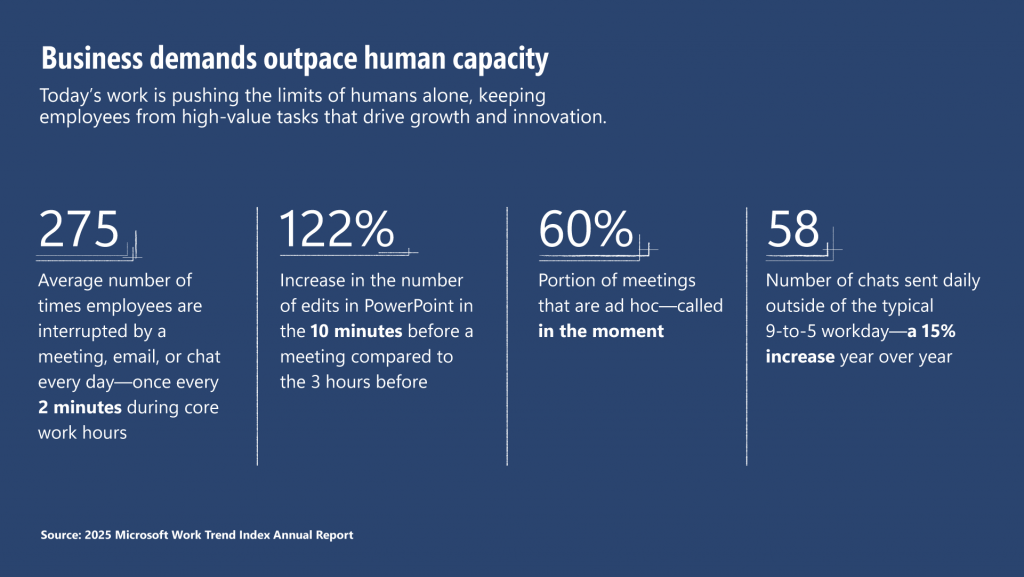
The scale of the problem is well documented. Microsoft’s 2025 Work Trend Index found that employees using Microsoft 365 are interrupted roughly every two minutes during core hours, about 275 times a day, and that nearly half of employees and more than half of leaders say their work already feels chaotic and fragmented.
The pattern predates the chat era. Back in 2012, the McKinsey Global Institute estimated that knowledge workers spent about a fifth of the week, roughly one full day, looking for information. Frontline teams often have it worse, because their information lives in even more places. AI agents cut into that time by letting employees ask for what they need in plain language and get an answer on the spot. Many employees are already reaching for AI to close the gap on their own: MIT’s Project NANDA found that workers at over 90% of the companies it surveyed reported regular use of personal AI tools for work, “often without IT knowledge or approval,” which is what makes shadow AI a frontline security issue.
Why AI Agents Are Different From Traditional Chatbots
A lot of organizations still picture AI as a chatbot. Traditional chatbots were built to retrieve information: ask a question, get a document or a link back. Modern agents can read context, analyze data, recommend a next step, kick off a workflow, and tie several systems together.
Take an employee asking about a certification requirement. A chatbot hands back the policy document, and the employee still has to work out what it means for them. An agent can check the person’s role, decide whether the certification applies, assign the right training, flag it to a manager, and track completion until the training is done.
| Dimension | Traditional Chatbot | AI Agent |
|---|---|---|
| 1. Information vs. Execution | A chatbot answers a question by retrieving a static policy document or link. | An agent solves a problem by checking context, kicking off a workflow, and getting the task done. |
| 2. Bolted On vs. Built In | A chatbot operates in a siloed chat window, disconnected from underlying business systems. | An agent lives natively inside the workflow, orchestrating actions across scheduling, tasks, and learning. |
| 3. Transactional vs. Contextual | A chatbot processes single-turn, transactional queries without understanding the user’s specific environment. | An agent handles multi-turn conversations, adapting to the employee’s role, tenure, and current shift status. |
| 4. Passive vs. Agentic | A chatbot waits passively for an employee to type a query or report an issue. | An agent actively monitors operational data to spot patterns, surface opportunities, and recommend the next best action to managers. |
| 5. Generic vs. Compliant | A chatbot has no awareness of whether an employee is on the clock, which exposes organizations to wage-and-hour liability when it is used off-shift. | An agent is shift-fenced, so employees who are off the clock can’t use features that would count as compensable work, which protects the company’s compliance standing. |
Research Points Toward More Human Leadership
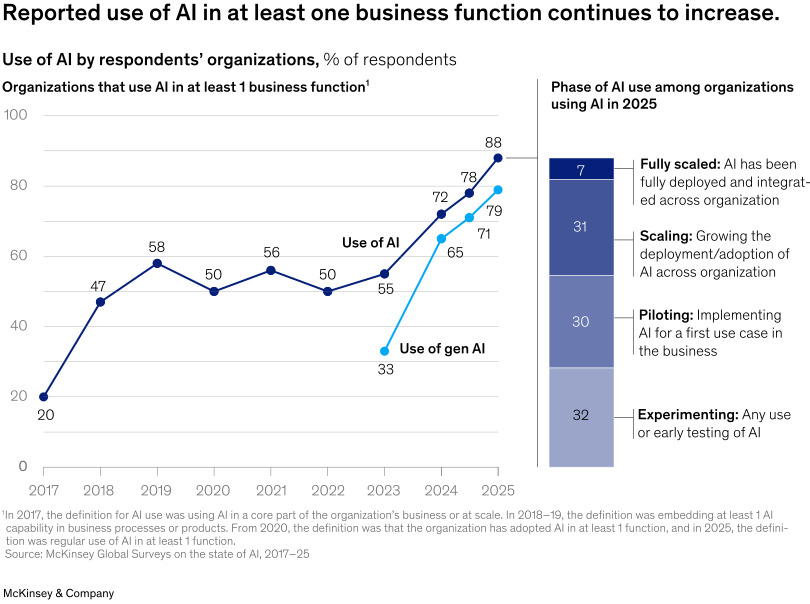
McKinsey’s research keeps landing on the same conclusion: the biggest gains from AI come when companies pair the technology with human expertise. In its 2026 State of AI survey, nearly nine in ten respondents reported regular use of AI in at least one business function. With use that widespread, the difference between companies comes down to how well they pair AI with the people making decisions.
That matters most on the frontline. A capable store manager or shift supervisor shapes engagement, retention, customer satisfaction, and safety in ways software can’t touch. Give those managers back the hours they lose to searching and reporting, and they spend them coaching and developing people, which is where the returns compound.
The Rise of Agentic Operations
After a first wave focused on surfacing information, AI is moving toward acting on it. An agentic system can watch workforce, operational, and customer data continuously and catch the things a manager would want to know early. Picture a distribution center manager opening the day to a short read on what’s drifting:
- training compliance slipping in one department
- overtime climbing past the acceptable threshold
- safety observations down over the past two weeks
- task completion lagging behind comparable sites
- turnover risk rising among recently hired associates
Each alert arrives with a recommended action, and that recommendation is where the value lies. The system spots the issue and suggests a response, and the manager decides how to handle it.
The Hidden Goldmine in Frontline Data
Most companies already hold a large amount of operational data. Workforce systems track schedules and labor hours, and learning systems record who has been trained. Task systems show what got done, while customer and communication platforms show how people are engaging.
The trouble is that this data sits in silos that don’t talk to each other. Read across those systems at once, and you start to see why outcomes happen and what to do about them next, which no single report from one system can tell you.
Insights Alone Create No Value
Good insights don’t produce good results on their own. A dashboard can show a compliance gap, but someone still has to close it.
Organizations need a way to turn a recommendation into action: communicate it, assign the task, deliver the training, adjust the schedule, and then check whether it worked. The companies that pull ahead will be the ones that wire intelligence straight into what their teams do every day.
From Intelligence to Workforce Orchestration®
Acting on what AI recommends takes a platform connected to the work itself, which is the job of Workforce Orchestration®. When an agent spots a training gap, the right course should be ready to assign. A flagged execution problem should turn into tasks that go out right away, and a staffing crunch should start the scheduling workflow without anyone chasing it, with a manager confirming each step. Connecting insight to execution this way is what turns a recommendation into a result you can measure.
Why Humans Become More Valuable
The better AI gets, the more the human skills stand out. Empathy, coaching, and the knack for building a relationship or reading a room don’t automate away. An agent can flag a struggling employee, but a manager still has to have the conversation, and rallying a team around a new opportunity is still a leader’s job. The frontline organizations that get this right will put human leadership first and use the technology to support it.

The Future Frontline Experience
In the workplace this points to, AI works in support of people. Employees get answers on the spot and managers get time back for coaching. Leaders make better-informed calls, and customers notice it in the service they get.
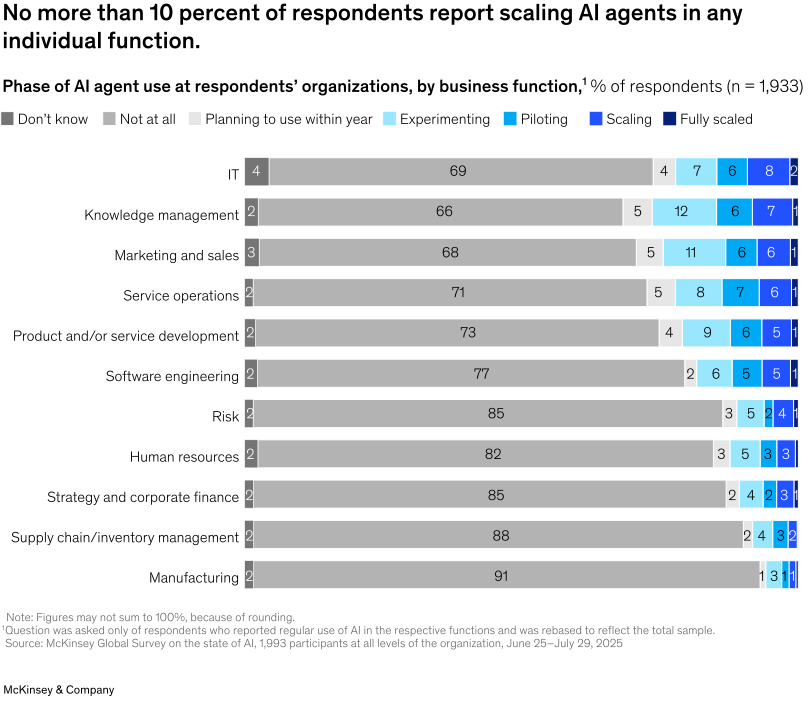
None of this is automatic, and it isn’t here at scale yet. In McKinsey’s 2026 survey, about two in ten respondents said their organizations had reached the scaling phase with AI agents. Used well, AI makes more room for the human side of frontline work.
Summary
The companies that get the most out of AI will use it to make managers better at the job and to create more room for the human contact that matters.
Microsoft’s researchers put the warning bluntly: without rethinking how work is structured, organizations “risk using AI to accelerate a broken system.” The organizations that come out ahead will connect AI insights to the work their teams do each day and give their people the tools to act on what they learn. That future is more human than the frontline most workers know today.
About the author:

Will Eadie
Chief Strategy Officer
Will Eadie is WorkJam's Chief Strategy Officer, and host of "The Frontline Factor: Hearts & Dollars" podcast, in which he explores the dynamics of the frontline workplace by bridging high-level strategy and everyday operations with expert insights and engaging discussions. The podcast offers valuable perspectives for business leaders, team managers, and frontline employees, and is updated monthly.