The Predictability Pay Trap: How $58.9 Million in Fines Happened One Shift Change at a Time
The Predictability Pay Trap: How $58.9 Million in Fines Happened One Shift Change at a Time
The two largest individual worker-protection settlements in U.S. history did not happen because Starbucks and Chipotle scheduled shifts badly. They happened because nobody at either company could see a violation the moment it occurred.
New York City’s Office of Labor Policy and Standards collected $38.9 million from Starbucks and $20 million from Chipotle for Fair Work Week violations, the shorthand for predictable scheduling laws that require advance notice and pay for late changes, part of more than $80 million in worker relief the city has secured since 2017. Both companies run sophisticated scheduling operations, with compliance and legal teams of their own. Neither caught the problem before an auditor did.
That gap is worth sitting with. It explains why Fair Work Week enforcement keeps landing on well-resourced national operators, not just the small businesses running spreadsheets and a printed schedule board in the back office.
A Violation That Completes Itself
Most compliance risk gives you time to react and correct:
- A wage calculation error sits in payroll until someone reconciles it.
- A missed safety inspection stays open until the next audit finds it.
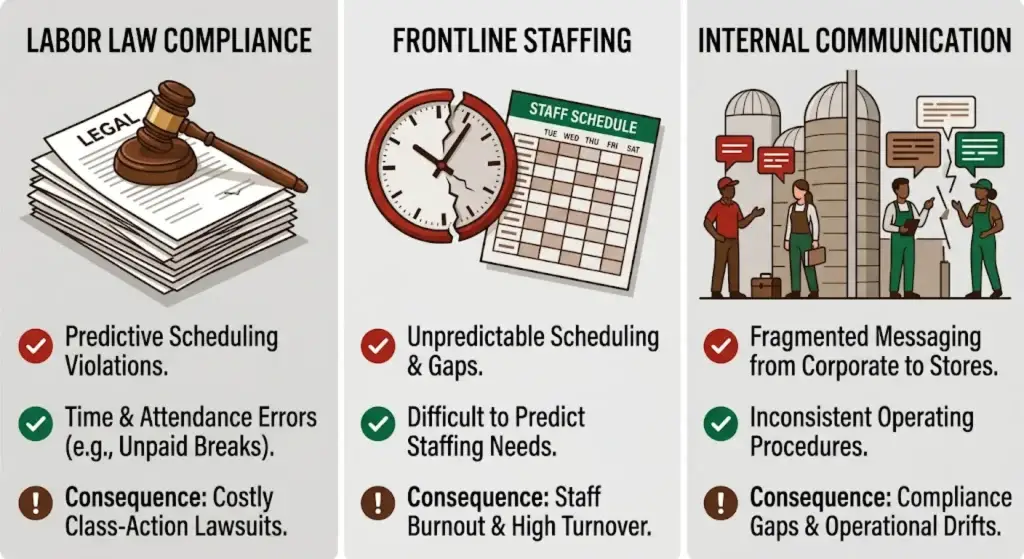
Predictability pay does not behave that way. In most Fair Work Week jurisdictions, once a schedule is posted, changing it inside the notice window, typically 14 days, triggers premium pay the instant the change is made. Cancel a shift with less than 24 hours’ notice and the worker is usually owed 50% of that shift’s pay, whether they ever ask for it or not.
The violation is not a policy failure that gets discovered later. It is a discrete event, completed the moment a manager saves a new schedule, and it repeats once per affected worker, per shift, across every location, every week. A wage audit looks backward at what already happened. Predictability pay has to be caught forward, at the moment the schedule changes, or it accumulates quietly until someone else does the counting.
Eleven Jurisdictions Now, More Arriving Every Year
Eleven jurisdictions actively enforce Fair Work Week laws as of this writing, up from one a decade ago. Three of them: Berkeley, Evanston, and Los Angeles County, came online within the eighteen months before this was published. Nine or more states currently have bills moving through their legislatures. For a single-location employer, that is a compliance question.
For an operator running hundreds of locations across multiple cities and states, each with its own notice period, premium rate, and records requirement, it starts to look like running a dozen different payroll systems inside one company, except the twelfth one didn’t exist two years ago, and the thirteenth is arriving next year.
The organizations getting caught are rarely the ones ignoring the law outright. They are the ones managing it manually, or semi-manually, across a footprint that grew faster than their tracking did. A regional manager approving a shift swap over text is not thinking about premium pay. Neither, presumably, was whoever made the equivalent call at Starbucks or Chipotle before the fines. The obligation existed anyway.
One objection to this reading: New York enforces harder than almost anywhere else, so of course New York produces the biggest numbers. That’s true, and it cuts the other way. New York’s Office of Labor Policy and Standards has brought dozens of cases precisely because it built the infrastructure to find violations that already existed. Every other jurisdiction on the list, Chicago, Philadelphia, Seattle, the state of Oregon, is at an earlier point on the same enforcement curve. The liability isn’t unique to New York. The visibility is.
Catch It at the Shift, Not at the Audit
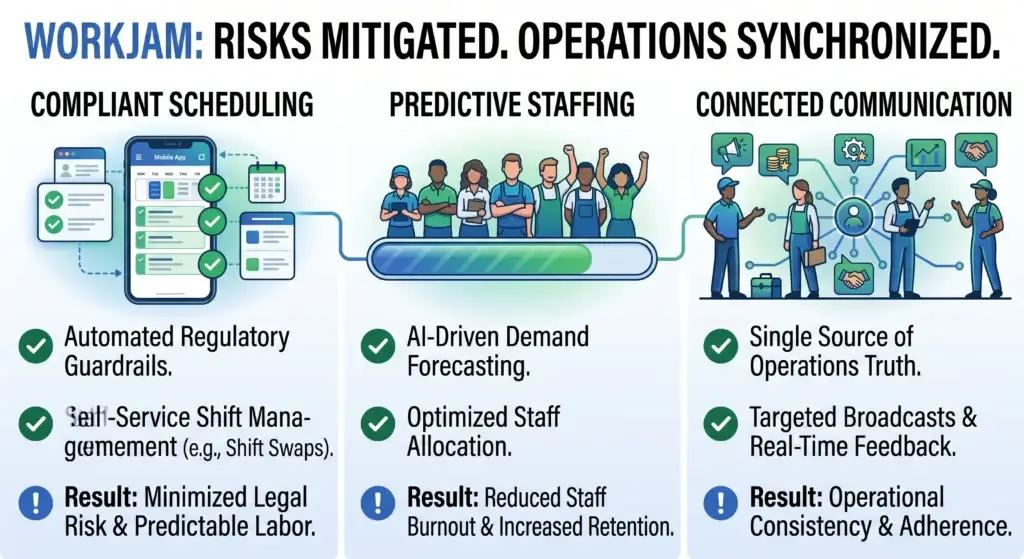
Both companies already had scheduling policies before they were fined. Policy was never the missing piece. What was missing was a system that flags the obligation at the moment the schedule changes, the same moment the liability is created, instead of during a legal review two years later. That is a real-time problem, and it needs a real-time answer.
This is the specific gap purpose-built scheduling platforms, including WorkJam, are built to close: automated compliance rule enforcement that catches an obligation the moment a shift changes, real-time schedule distribution, and multi-jurisdiction audit trails generated as the rules require, not assembled under pressure once a regulator asks for records.
Every dollar of the $58.9 million New York collected from two companies was, at some point, a single shift change nobody flagged in real time. That is the number worth remembering. Not because it is large, but because it was built one unflagged shift at a time, and it is still being built today at every retailer that has not closed that gap yet.
About the author:

Will Eadie
Chief Strategy Officer
Will Eadie is WorkJam's Chief Strategy Officer, and host of "The Frontline Factor: Hearts & Dollars" podcast, in which he explores the dynamics of the frontline workplace by bridging high-level strategy and everyday operations with expert insights and engaging discussions. The podcast offers valuable perspectives for business leaders, team managers, and frontline employees, and is updated monthly.