Fair Work Week Compliance: Policy vs. the Group Chat
Your Fair Work Week Violations Are Not Happening in HR. They’re Happening in the Group Chat.
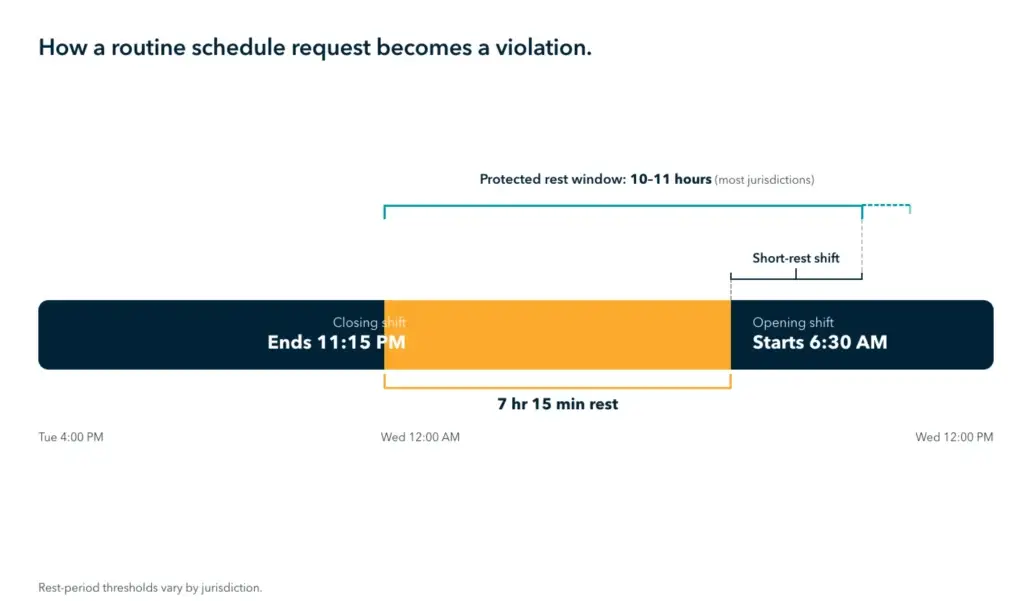
Every large retailer with Fair Work Week exposure has a policy document that says the right thing. Somewhere in a handbook or a compliance training module, it lays out the notice period, the premium pay rules, the rest requirements between shifts. None of that paper stops the violation that actually happens at 6:40 on a Tuesday evening, when a store manager texts an employee to ask if they can close tonight and open again tomorrow.
What is Fair Work Week Exposure? Fair Work Week exposure is shorthand for predictable scheduling laws that require advance notice and pay for late changes.
The manager is not thinking about Fair Work Week law in that moment. They are thinking about a callout twenty minutes before close and a delivery truck that needs unloading before the store opens. Whether that text creates a violation, a short-rest shift inside the 10-to-11-hour window most jurisdictions protect, or a schedule change that triggers predictability pay, depends on the jurisdiction, the worker’s classification, and how the request gets logged, and none of that is on the manager’s mind or needs to be. That is the wrong moment to expect someone to be a compliance expert.
The Handbook Was Never Going to Reach the Sales Floor
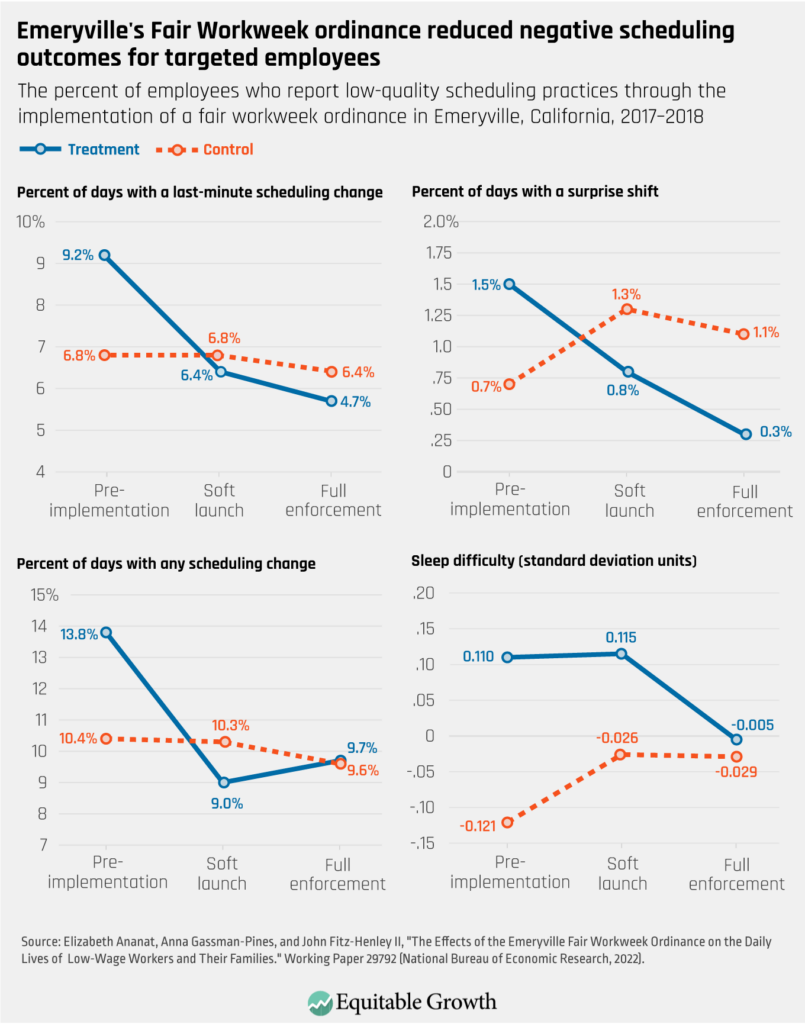
Fair Work Week laws apply at the organizational level. The violations happen at the supervisor level, one shift swap, one call-in, one clopening request at a time. A policy document filed in an employee handbook does not reach that moment. Neither does an annual training module that gets clicked through in November and forgotten by February. The gap between what the organization knows and what the store manager does in real time is where the liability actually lives. Labor law policies play a crucial role in ensuring fair treatment of employees. When these policies are not effectively communicated or enforced, it creates uncertainties for both supervisors and staff. Managers must actively engage with labor law policies to bridge the gap between organizational intent and on-the-ground realities.
This is not a story about careless managers. Most of them are solving a real staffing problem with the tools in front of them, usually a phone and a group chat. Increasingly, those tools include free AI apps as well, and shadow AI carries its own security risk: company data leaves your control with every prompt. The store still needs to open. The truck still needs unloading. A manager who has never been told that a schedule change nine days out triggers a different pay rule than a change three days out is not going to intuit it under pressure, and the handbook in the back office was never open at 6:40 on a Tuesday to begin with.
It gets harder, not easier, for a manager running multiple locations or covering a district. Eleven jurisdictions enforce Fair Work Week rules as of this writing, each with its own notice period, premium rate, and rest requirement. A district manager covering stores in two of them is not just managing staffing across those stores. They are unknowingly managing two different legal standards for the same kind of decision, with no indication at the moment of the text message which standard applies to which store.
What Actually Changes a Manager’s Decision
Training does not fail because managers are not paying attention. It fails because it is delivered at the wrong moment, once a year, in the abstract, disconnected from the specific shift a specific manager is looking at on a specific evening. Behavior changes when the compliant option is also the easiest option: a system that flags a predictability pay obligation the instant a shift moves inside the notice window, that surfaces a rest-window conflict before the schedule posts rather than after a worker complains, and that routes a shift swap through eligibility and compliance rules automatically instead of through a side-channel text thread nobody is auditing.
That is the direction purpose-built platforms like WorkJam are built to close: automated compliance rule enforcement built into the scheduling workflow itself, so a manager solving tonight’s staffing gap does not have to know eleven jurisdictions’ worth of notice periods to stay inside them.
The organizations getting ahead of Fair Work Week risk are not the ones with the best-written handbook. They are the ones whose systems make the compliant path the obvious one, so a manager under pressure on a Tuesday evening follows the law without ever having to think about it.
About the author:

Will Eadie
Chief Strategy Officer
Will Eadie is WorkJam's Chief Strategy Officer, and host of "The Frontline Factor: Hearts & Dollars" podcast, in which he explores the dynamics of the frontline workplace by bridging high-level strategy and everyday operations with expert insights and engaging discussions. The podcast offers valuable perspectives for business leaders, team managers, and frontline employees, and is updated monthly.