The Best-Store Fallacy
What an organization gives up when it treats one store, on one day, as the model for all the others.
Every retail operations leader has heard the pitch. Find your best store, figure out what it does differently, and roll that playbook out to the other four hundred. It sounds like discipline, and an entire category of software has been built on it. Yet the fleets that have run this play the longest keep seeing a familiar pattern. The same stores top the ranking year after year while the middle stays stuck, and the playbook that was supposed to close the gap quietly disappears from the operations review.
The play fails consistently enough to deserve its own name, so call it the best-store fallacy. The fix is not a better playbook. It is a different model of how an organization learns.
You can’t copy a trade area
Start with what a best store’s performance is made of. Research on multibillion-dollar retail companies, published through the National Bureau of Economic Research, has found that roughly half of the variation in store-level productivity comes from fixed characteristics like location, trade area, and local competition. The other half comes from how the store is operated, and within that operational half, the quality of the store manager’s decision-making is the single largest factor, accounting for 25 to 35 percent of total productivity variation.
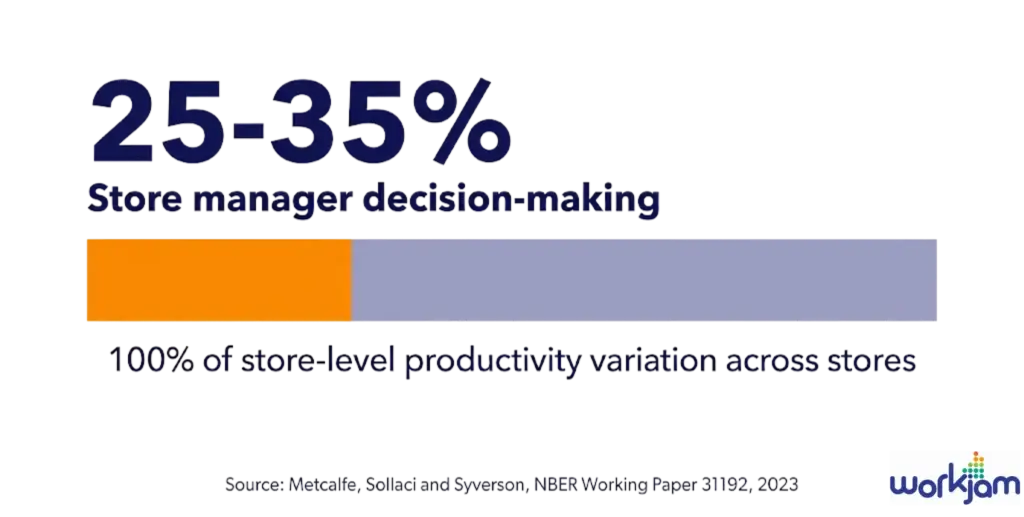
Sit with the first half of that finding, because it is the half the replication pitch skips. Roughly half of what separates your best store from your median store consists of conditions the store inherited rather than choices anyone made there, and no rollout will copy a trade area or relocate foot traffic.
None of this is news to an operator. Retail clusters stores into volume bands, formats, and climate zones precisely because everyone knows conditions rule, and nobody expects a strip mall to run a flagship’s playbook. What the research adds is the size of the share, roughly half, and the size is the problem. Every comp ranking that frames the gap to the top store as an execution question is treating that half as a rounding error.
The operational half transfers badly too, for a subtler reason. Behaviors and conditions are entangled. What looks like a best practice is usually a practice that works in that store’s conditions. The staffing model that makes a high-traffic flagship hum will bury a low-volume suburban location in labor cost. A recovery routine built around one customer rhythm falls apart in front of another. Lift the behavior out of the context it grew in, and the thing that made it work stays behind.
The best store you studied no longer exists
Even a perfect copy would be a copy of the past. A playbook freezes one store at one moment, and by the time it has been written, blessed, and rolled out, that moment is gone. The model store itself has moved on: the assistant manager who made mornings run has been promoted, and the season that flattered its numbers has turned. Study the same store again next quarter and you would write a different playbook.
The store on the receiving end is living in a moment of its own. A callout at open and a truck that showed up late can rewrite the morning’s priorities before nine. The work that matters most in a store changes shift by shift, and on some days hour by hour. A playbook can describe what mattered somewhere, once, and the floor keeps moving the day after it is printed.
Replication learns at exactly one level
The deeper problem is structural. A retail organization is built in levels for a reason. A store faces conditions each day that its district cannot see from above. The patterns in a district’s numbers, in labor or shrink or execution quality, need a dozen stores’ worth of signal before they can be read at all. Regions differ in ways that have nothing to do with effort. The fleet as a whole moves to rhythms, seasonal, promotional, competitive, that only become visible at full scale.
Best-store replication flattens all of that into a single exemplar and a few hundred copies. It learns at one level, the level of the winning store, and broadcasts the lesson as if the organization had no structure at all. Every store below the winner gets treated as a defective copy of it. The variance between locations gets treated as noise to be stamped out, when most of that variance is information about conditions the playbook was never built for. No operator would run a fleet as one undifferentiated span of control, yet that is the learning model the replication play assumes.
Volume banding is the industry’s standing concession to all of this, three or four playbooks instead of one. The concession proves the point and stops short of it, because a band is not a store, and a band average is not this Tuesday.
Every level has something to teach
The alternative treats the organization’s structure as the learning architecture itself. Each store learns from its own results, and the work it is asked to do gets decided for that store, at that moment, rather than lifted from a flagship three states away. One level up, districts and regions surface patterns no single location can see, and at the top sit the truths that genuinely hold everywhere. It is also why a district manager’s store visits should start from what the district data shows about each location. What lands on any single store’s floor is shaped by its own reality, sharpened by everything learned above it, and because the learning never stops, it moves when the store does.
Watch a single planogram reset travel through those levels and the idea stops being abstract. One store’s history shows its resets go cleaner the day after its truck, with the closing crew, so that is when the work shows up there. Across a district, eight of twelve stores fail photo review on the same bay, and the pattern points at the instruction, since eight teams do not miss the same bay by coincidence. The fix goes to the document, and nobody gets coached for a document’s mistake.
The region’s lesson arrives in the sales data. The reset executes on schedule everywhere, yet the lift shows up in only half its trade areas. That makes the miss a merchandising call headed back upstream, and nobody spends a month asking whether the stores did the work. And the fleet banks the last lesson. The revised instructions go out with a reference photo of the finished bay, and because the stores that reset on them pass review the first time, every rollout after this one ships that way. One event, four different lessons, each caught at the only level positioned to see it.
Every-Level Learning
One planogram reset. Four different lessons.
Each level of the organization can see something the others structurally cannot.
| Level | Stores in view | What only this level can see | Where the lesson goes |
|---|---|---|---|
| Fleet | 500 stores | Reference photos cut first-pass failures across every rollout | Every future rollout |
| Region | ~60 stores | Executed on schedule, but lift in only half the trade areas | Merchandising, upstream |
| District | 12 stores | 8 of 12 fail photo review on the same bay | The instruction document |
| Store | 1 store | Resets run cleaner the day after the truck, with the closing crew | This store’s schedule |
A broadcast model would catch one of these and send it everywhere. Each lesson is only visible at one altitude, and belongs to a different destination.

Within that model, the best store still matters. It matters as a signal rather than a template. When a top store’s results move, the useful question is which level the lesson belongs to. Some of what it does is a fleet truth that deserves to travel everywhere. Some of it works only above a certain traffic threshold, or only with the tenured team it happens to have.
The median is where the money is
A replication program points the whole exercise at the top of the ranking, which was doing fine without the attention. Most of a fleet’s revenue sits in the middle of the distribution, in the two or three hundred stores that never headline a case study. That is where a learning system earns its keep, and the honest test of one has two parts: whether the median store is moving, and whether the spread between the middle and the bottom is tightening. A rising flagship is a story. A rising median is a P&L event.
The arithmetic is worth doing on the back of an envelope, with your own numbers. Take a 500-store fleet whose median store does $8 million a year. Concede up front that half of what separates stores is conditions no system will change. The addressable half is operational, and the system does not need to conquer it, only nudge it. Move the stores around the median by one percent and that is $80,000 a store, roughly $20 million a year across the couple hundred stores clustered in the middle, from a gain small enough to hide inside a weekly variance report. That is revenue alone, before the same learning touches labor hours and shrink. Then let the system keep learning, so year two starts from a smarter baseline than year one did, and the gain stops being an event and becomes a rate.
Moving a median takes a system that can place every lesson at the level it belongs to, which is the judgment a broadcast model never exercises. That principle is what we built WorkJam’s AI architecture around, and we gave it a name, Every-Level Learning. The platform is the system frontline teams already run their day in, across communications, tasks, shifts, and learning, so every completed task, audit score, and survey response becomes signal the AI can learn from. It decides with the live state of the floor in view, who is on shift and what has changed since morning, and every outcome feeds back into the next decision at every level the organization is built on. And when a manager overrides it, that override teaches it too, because a person on the floor knew something the data had not caught yet. The judgment of your best operators stops being trapped inside their own four walls.
The replication pitch was always reaching for something real. Underneath it is the wish every operations leader carries, to take the judgment of your best people and make it work everywhere they are not. That wish is worth keeping. A playbook cannot carry judgment across four hundred stores having four hundred different days. A system that learns at every level can.
Frequently Asked Questions
What is the best-store fallacy?
Find your best store, figure out what it does differently, and roll that playbook out to the other four hundred. The play fails consistently enough to deserve its own name, so call it the best-store fallacy. The fix is not a better playbook. It is a different model of how an organization learns.
Why doesn’t best-store replication work in retail?
Behaviors and conditions are entangled. What looks like a best practice is usually a practice that works in that store’s conditions. The staffing model that makes a high-traffic flagship hum will bury a low-volume suburban location in labor cost. Lift the behavior out of the context it grew in, and the thing that made it work stays behind.
How much of store performance comes down to the store manager?
Research on multibillion-dollar retail companies, published through the National Bureau of Economic Research, has found that the quality of the store manager’s decision-making is the single largest operational factor, accounting for 25 to 35 percent of total productivity variation.
What is Every-Level Learning?
The alternative treats the organization’s structure as the learning architecture itself. Each store learns from its own results, and the work it is asked to do gets decided for that store, at that moment, rather than lifted from a flagship three states away. One level up, districts and regions surface patterns no single location can see, and at the top sit the truths that genuinely hold everywhere.
Why does the median store matter more than the best store?
Most of a fleet’s revenue sits in the middle of the distribution, in the two or three hundred stores that never headline a case study. That is where a learning system earns its keep, and the honest test of one has two parts: whether the median store is moving, and whether the spread between the middle and the bottom is tightening. A rising flagship is a story. A rising median is a P&L event.
About the author:

Will Eadie
Chief Strategy Officer
Will Eadie is WorkJam's Chief Strategy Officer, and host of "The Frontline Factor: Hearts & Dollars" podcast, in which he explores the dynamics of the frontline workplace by bridging high-level strategy and everyday operations with expert insights and engaging discussions. The podcast offers valuable perspectives for business leaders, team managers, and frontline employees, and is updated monthly.