Why Frontline Employee Communication Breaks at Campaign Execution
Why complex, multi-step frontline employee campaigns require more than messages, tasks or training delivered in isolation.
The short version: Frontline employee communication tells people what changed. A multi-step campaign asks them to do something about it: complete training, execute a checklist, submit photo evidence, get manager approval, give feedback. Those steps run over weeks, vary by location and role, and often depend on each other. When they live in separate systems, the campaign team becomes the integration layer, holding it together by hand. That is where large frontline campaigns actually fail, and it is not a communication problem.
Most large frontline campaigns look great in the strategy deck.
There is a launch date, a communications calendar, a set of key messages and a timeline showing how everything will roll out.
Then the campaign reaches the frontline.
Suddenly, the organization has to answer a much harder set of questions:
- Who needs to receive the message today?
- Who needs a different message based on their location, role or stage in the campaign?
- Who has acknowledged it?
- Who has completed the required training?
- Who has executed the work?
- Who has provided evidence that it was done correctly?
- Where is the campaign falling behind?
- What feedback is coming from the field?
- Who needs to intervene before a small issue becomes a big one?
That is when a communications plan becomes an operational challenge.
Whether the organization is running a network-wide store refresh, launching a new retail merchandising program, preparing for a major sales week, introducing new equipment or conducting a month-long safety campaign, success depends on much more than sending information.
It requires frontline orchestration: the coordination of every step a campaign needs, from targeted communication through training, tasks, evidence and approval, delivered in the right order across locations and roles.
Employee Communication Creates Awareness, Orchestration Creates Action
Communication is obviously important. Frontline employees need to understand what is changing, why it matters and what is expected of them.
But awareness is only the beginning.
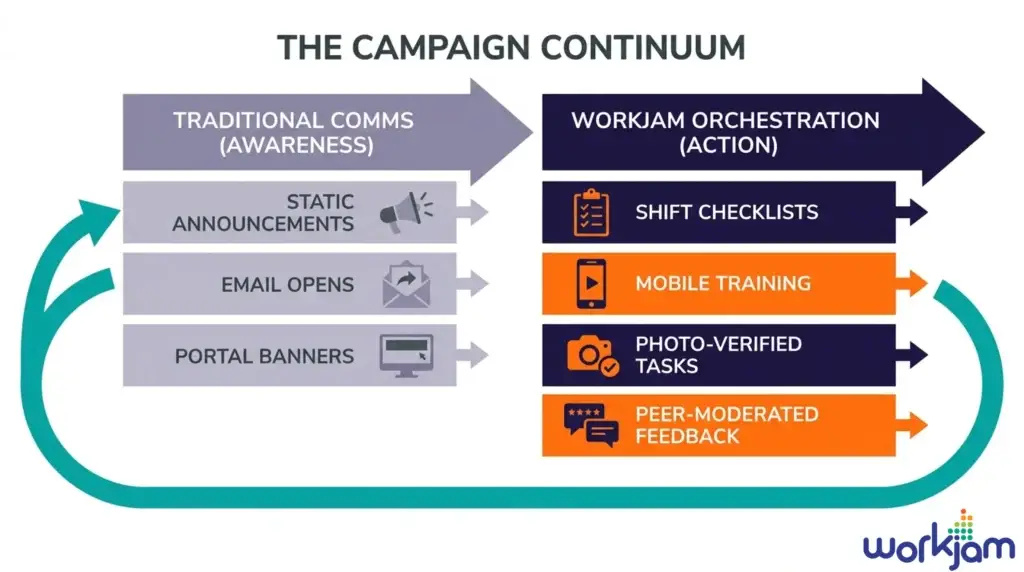
A campaign usually requires people to move through a sequence of actions. They may need to watch a video, review a policy, complete training, acknowledge a change, execute a checklist, submit a photo, participate in a manager conversation, provide feedback and take follow-up action.
Those steps may happen over several weeks or months. They may vary by market, site, role, department or campaign phase. They may also depend on the completion of an earlier activity.
A communications platform can distribute the message.
A frontline orchestration platform coordinates the entire journey.
That distinction matters because campaigns rarely fail in the strategy deck. They fail in the handoffs between communication, learning, scheduling, task execution, feedback and reporting.
What a Multi-Step Campaign Actually Looks Like
Consider a network-wide refresh involving hundreds or thousands of locations.
The organization may begin with an enterprise announcement explaining the initiative and building excitement. Everyone needs to understand the broader mission, but not everyone needs to take action yet.
Several months later, the campaign reaches a specific market. Leaders and employees in that market now need more detailed information, while the rest of the organization does not.
As the launch approaches, the audience may split again.
Impacted locations need timelines, training, preparation checklists and instructions. Locations that are not included may need a different message explaining the decision, supported by a structured conversation with their manager.
Closer to execution, employees may need to complete role-specific learning, prepare inventory, install materials, follow new procedures or submit photo evidence. Managers may need to plan labor, review progress, approve completed work and escalate issues.
After the launch, the organization needs to collect feedback, identify problems, measure sentiment and share success stories with the next group of locations.
That is one campaign, but it contains dozens of connected operational motions.
If those motions live in different systems, spreadsheets, inboxes and shared drives, the campaign team becomes responsible for manually holding everything together.
That does not scale.
Why Do Point Solutions Fail at Campaign Execution?
Point solutions each track their own activity and none tracks the outcome. Email shows a message was opened. The LMS shows a course was passed. The task tool shows a checklist was closed. No single system shows whether the employee understood the change and executed the work correctly at the site.
Many organizations try to execute campaigns using a combination of email, an intranet, a standalone task tool, an LMS, a survey platform and a spreadsheet.
Each tool may do its individual job reasonably well.
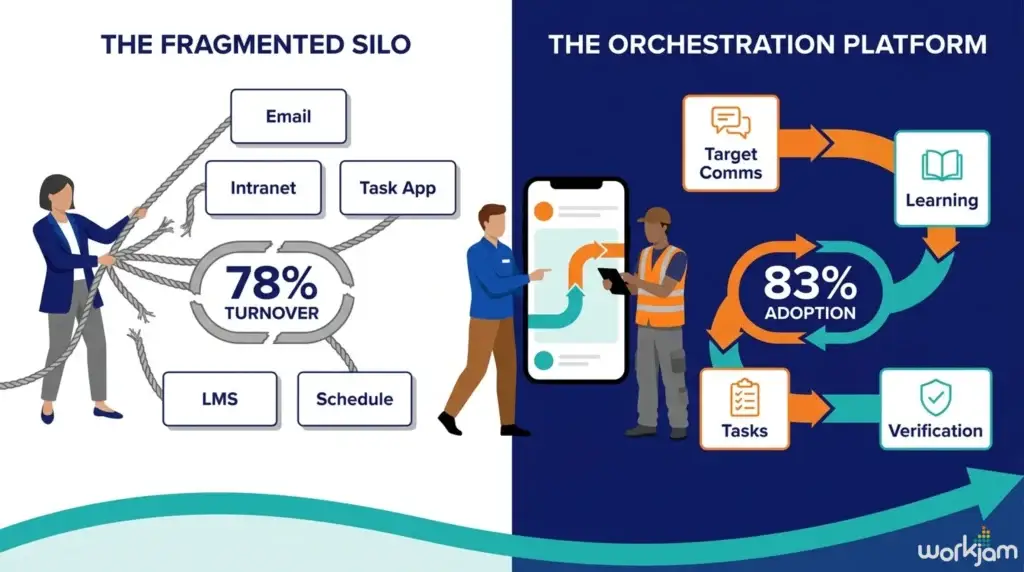
The problem is that the campaign does not experience them as individual jobs.
The communication team may know that a message was opened, but not whether the required work was completed.
The learning team may know that someone passed a course, but not whether the new process was executed correctly at the site.
The task system may show a completed checklist, but not whether the employee understood the reason behind it.
The scheduling system may show that labor was available, but not whether it was aligned with the campaign workload.
The survey platform may collect feedback, but the response may never trigger an operational intervention.
Each system produces activity. None of them provides the complete picture.
The frontline employee feels the fragmentation too. One message is in email. The training is somewhere else. The checklist is printed in the back room. The latest instructions are buried in a shared drive. Feedback goes to an inbox that may or may not receive a response.
That is not a campaign experience. It is a scavenger hunt.
The Frontline Needs One Place to Understand and Act
A full frontline orchestration platform gives every employee one place to answer three simple questions:
- What is changing?
- What do I need to do?
- What do I need to do today?
The platform should bring together the campaign announcement, targeted communications, tasks, learning, reference materials, schedules, surveys and feedback.
More importantly, those capabilities need to work together.
A single publishing workflow should be able to launch a targeted communication, place a campaign card on the employee home screen, assign an acknowledgement task and make the supporting resources available.
Completing training should be able to unlock the next task.
A checklist should include instructions, due dates, approval processes and photo evidence.
A manager should be able to see which locations are on track, which are falling behind and where intervention is required.
Employees should not have to determine which application contains the next step. The platform should guide them through it.
That is the difference between giving the frontline access to information and enabling the frontline to execute.
The Platform Has to Be Easy at Both Ends
There is another requirement that does not get enough attention.
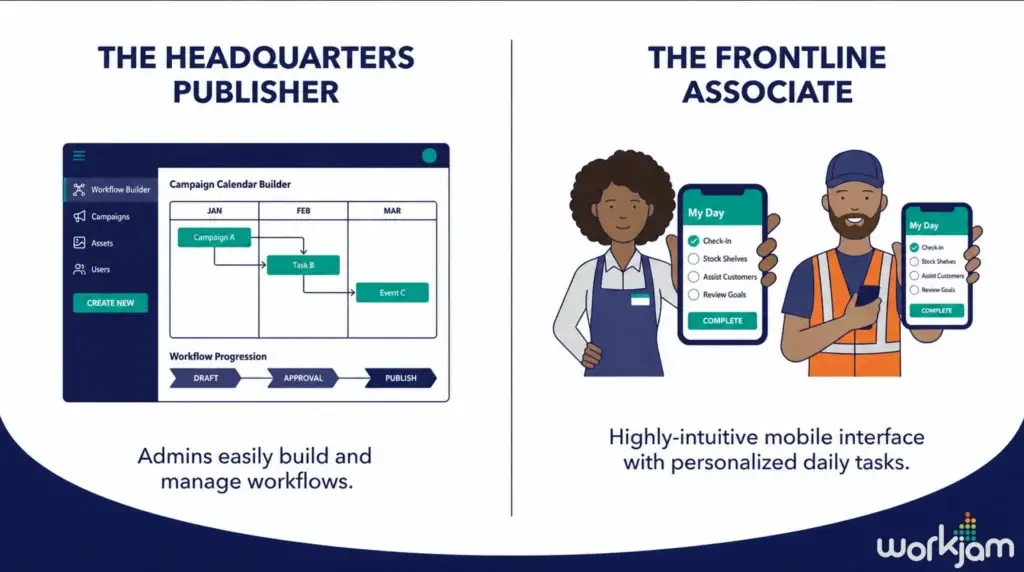
The platform must be as easy for the person publishing the campaign at headquarters as it is for the frontline employee being asked to execute it.
If the publishing experience is too complicated, campaign teams fall back on spreadsheets, email lists, shared drives and manual follow-up. Content becomes inconsistent. Targeting becomes unreliable. Every new market or location requires the team to rebuild the campaign from scratch.
If the frontline employee experience is too complicated, adoption falls. Employees miss steps, managers create workarounds and the organization loses visibility into what is really happening.
Ease of use is not just a design preference. It is an operational requirement.
For the publisher at headquarters, WorkJam makes it possible to build a campaign once and coordinate the moving parts from one platform.
The team can create the message, define the audience, select the publishing date and connect the communication to the required tasks, learning, surveys and resources. Targeting can be based on market, location, department, job role or campaign status, without manually maintaining lists of employees or store numbers.
Once the campaign playbook is built, it can be reused. The second market can be launched as a version of the first instead of being recreated. Timelines, content and workflows can be adjusted while the overall campaign structure remains consistent.
The publisher can also see acknowledgement, training, task completion, approvals, evidence and feedback in one place. If a location is falling behind, the campaign team can remind, republish or escalate without leaving the platform.
For the frontline employee, the experience is completely different, but just as simple.
They do not see the complex workflow behind the campaign. They see what applies to them.
The announcement, training, task, schedule, reference material and feedback mechanism are all available in the same app they already use. The employee can watch the video, acknowledge the message, complete the training, perform the task, submit evidence or ask a question without searching across multiple systems.
The experience is personalized, mobile and clear. Employees know what has changed, why it matters and what they are expected to do next.
WorkJam handles the complexity in the background so the experience remains simple at the frontline.
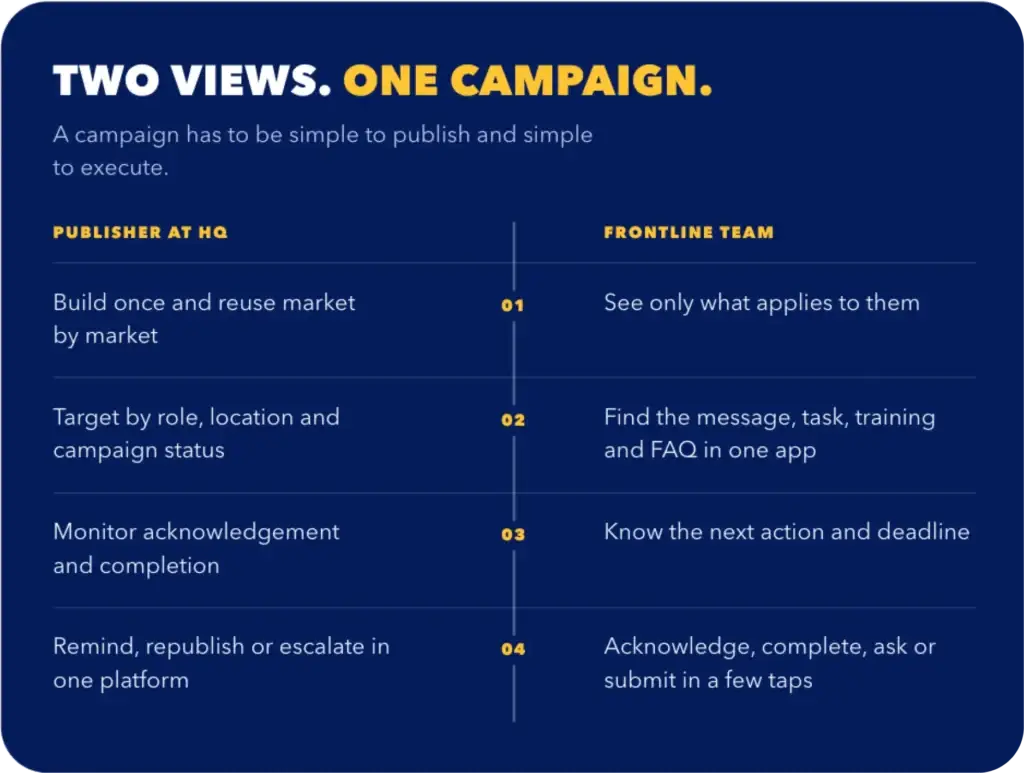
That balance is essential.
A campaign cannot scale if headquarters struggles to publish it. It cannot succeed if the frontline struggles to act on it.
WorkJam makes both sides of the campaign easier: simple to build, simple to repeat and simple to execute.
How Do You Target a Campaign Without Overwhelming Everyone?
Target every element of the campaign by location, market, department, job role, employee attribute and campaign status rather than broadcasting to the whole organization. A store manager needs an execution plan. An employee needs a short training module and a task for their next shift. An unaffected site needs only an explanation.
Large campaigns are rarely truly enterprise-wide at every stage.
Different people need different information at different times.
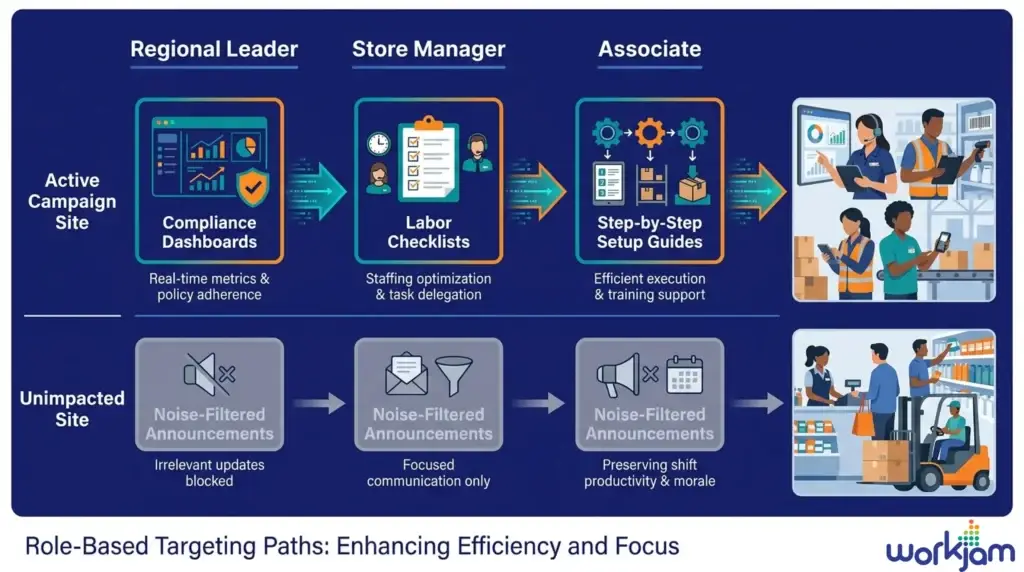
A store manager may need a detailed execution plan. A frontline employee may need a five-minute training module and a task for their next shift. A regional leader may need a dashboard showing completion and risk across multiple locations. An unaffected site may only need an explanation of what is happening elsewhere.
Broad communication creates noise. Precision creates relevance.
A frontline orchestration platform should target every element of the campaign by location, market, department, job role, employee attribute and campaign status.
That precision allows the organization to publish once without treating everyone the same.
It also protects the employee experience. People receive information because it applies to them, not because they happen to be somewhere on a distribution list.
How Do You Prove a Frontline Campaign Was Executed?
Measure completion, not delivery. Track acknowledgement, training completion, knowledge-check results, on-time task completion, approvals, submitted evidence and sentiment by location. Then turn those signals into action: reminders, reassignment, additional learning or escalation, without rebuilding the campaign in another system.
Launching a campaign is not the same as executing one.
The organization needs proof that the campaign reached the frontline and produced the intended action.
That means measuring more than views.
- Did people acknowledge the change?
- Did they complete the training?
- Did they pass the knowledge check?
- Were the required tasks completed on time?
- Was the work approved?
- Did the location provide the required evidence?
- Where are questions or negative sentiment increasing?
- Which sites require support?
The platform should turn those signals into action. It should allow the campaign team to send reminders, reassign work, provide additional learning or escalate a problem without rebuilding the campaign somewhere else.
That creates a closed loop from communication to execution, from execution to insight and from insight to intervention.
Without that loop, organizations learn about problems after a launch has already gone sideways.
The Model Works Across Every Kind of Campaign
The operational pattern is remarkably consistent.
A merchandising campaign requires targeted instructions, planogram training, installation tasks, photo evidence and approval.
A major sales week requires product knowledge, updated talking points, labor alignment, daily communications and rapid feedback from the field.
A safety campaign requires training, inspections, toolbox talks, employee attestations, incident reporting and proof of compliance.
A new product launch requires awareness, role-specific learning, inventory preparation, execution checklists and customer feedback.
The content changes. The orchestration model does not.
That repeatability is one of the biggest advantages of a unified platform. The organization can build the campaign framework once, use it across multiple waves and improve it as new data comes back from the frontline.
The second market should be easier than the first. The hundredth location should benefit from everything learned at the first ninety-nine.
This Is What WorkJam Is Built to Do
WorkJam brings communications, task management, learning, knowledge, surveys, scheduling, labor planning and frontline feedback into one platform.
Campaign teams can target content precisely, coordinate each phase, automate connected workflows and see progress across locations in real time.
Frontline employees get one place to understand the campaign, complete the work, access support and make their voices heard.
Managers get visibility into what has happened, what has not happened and where they need to act.
That is the real requirement behind any complex frontline campaign.
Companies do not need another place to post an announcement.
They need a platform that is easy to publish from, easy to act in and powerful enough to connect every step.
They need a platform that can turn intent into action, action into proof and proof into continuous improvement.
Because a campaign is not successful when the message is sent.
It is successful when the frontline executes.
Frequently Asked Questions
What is frontline orchestration?
Frontline orchestration is the coordination of every step a frontline campaign requires: targeted communication, assigned training, sequenced tasks, submitted evidence, manager approval and collected feedback, delivered to the right people in the right order across locations, roles and campaign phases. It covers the full path from announcement to verified completion, not just the message.
What is the difference between frontline communication and frontline orchestration?
Communication creates awareness. Orchestration produces action. A communications platform distributes the message. An orchestration platform coordinates the training, tasks, approvals and feedback that follow it.
Why do frontline campaigns fail during execution?
They fail in the handoffs between communication, learning, scheduling, task execution, feedback and reporting. When those functions run in separate systems, the campaign team has to hold everything together manually, which does not scale across hundreds or thousands of locations.
What does a multi-step frontline campaign involve?
A network-wide rollout typically moves through an enterprise announcement, market-level detail, location-level targeting, role-specific training, preparation checklists, installation or execution tasks, photo evidence, manager approval, and post-launch feedback collection, over weeks or months.
Why don’t point solutions work for campaign execution?
Each tool reports its own activity without connecting to the others. The result is a campaign that produces plenty of data and no complete picture, and a frontline employee hunting across email, an LMS, a printed checklist and a shared drive.
How do you measure whether a frontline campaign was executed?
Beyond views: acknowledgement rates, training completion, knowledge-check results, on-time task completion, approvals, submitted evidence, and where questions or negative sentiment are rising by location.
About the author:

Will Eadie
Chief Strategy Officer
Will Eadie is WorkJam's Chief Strategy Officer, and host of "The Frontline Factor: Hearts & Dollars" podcast, in which he explores the dynamics of the frontline workplace by bridging high-level strategy and everyday operations with expert insights and engaging discussions. The podcast offers valuable perspectives for business leaders, team managers, and frontline employees, and is updated monthly.