The Frontline Communications Platform Trap
If you own frontline communications, your instinct is to keep the keys. You are the reason the message stays clear, consistent, and on standard. So when someone suggests letting field leaders or franchisees post their own communications, what you hear is noise and risk: more voices, less control, an employee experience you no longer own. That instinct is right. Loosening the wrong way is exactly how the app fills with clutter and the message drifts.
But no matter how tightly you hold the keys, one thing does not go away: a real organization has communications that genuinely need to originate below headquarters.
Who Can Actually Publish Communications?
The most common version is field structure. In any organization with locations spread across a geography, district and regional leaders need to direct their own teams, and this is not only a retail pattern. Anywhere there is a layer of leadership between headquarters and the frontline, that layer has things it needs to say, and things it needs done: a market-specific push, guidance corporate was never going to write, or, when a storm is coming, a task sent to every store in its path to board up the windows tonight.
The Messages That Don’t Come From HQ
Much of it is smaller and just as necessary. A store manager tells the team about a broken cooler or the priorities for the day, or assigns someone the task of resetting a display before open. A function lead in loss prevention or merchandising directs their own people and no one else. None of this belongs at HQ, and none of it would ever originate there.
It gets sharper in a multi-brand company. Take a family like Catalyst Brands, spanning names as different as Brooks Brothers and JCPenney. One message sent to everyone would be wrong, because the brands do not operate the same way, with different promotional calendars, different hours, and a policy that is mandatory for one banner and irrelevant to the next. Even the look of the app is part of how a brand communicates, and that belongs at the brand level. At the same time, headquarters still has to run the whole portfolio and see across every brand at once, because the pattern that works in one is often the answer for another.
And in a franchise organization, it is not optional at all. Operators have to reach their own staff with operational messages HQ has no part in: local hours, a store-specific process, a change that applies to their locations and nowhere else.
None of this is stores asking for a bigger voice. It is the organization needing the right communications, and the right work, to come from the right level. That need is structural. It exists whether or not your tools support it, and it does not go away when you say no.
The Architectural Gap You Discover Three Months In
It usually goes wrong quietly, and rarely through a careless decision. A company evaluates a comms tool, it demos well for the job in front of them, headquarters to store, and they buy. The rollout goes fine. Then, a few months in, the shape of the real organization asserts itself.
Nobody raised it during the buying process, because the tool did exactly what it promised for the scenario they tested. The limit was not in the feature list. It was in the architecture, and architecture is the one thing you cannot configure your way out of later. A platform built so that one place publishes will only ever let one place publish, whatever your org chart actually looks like.
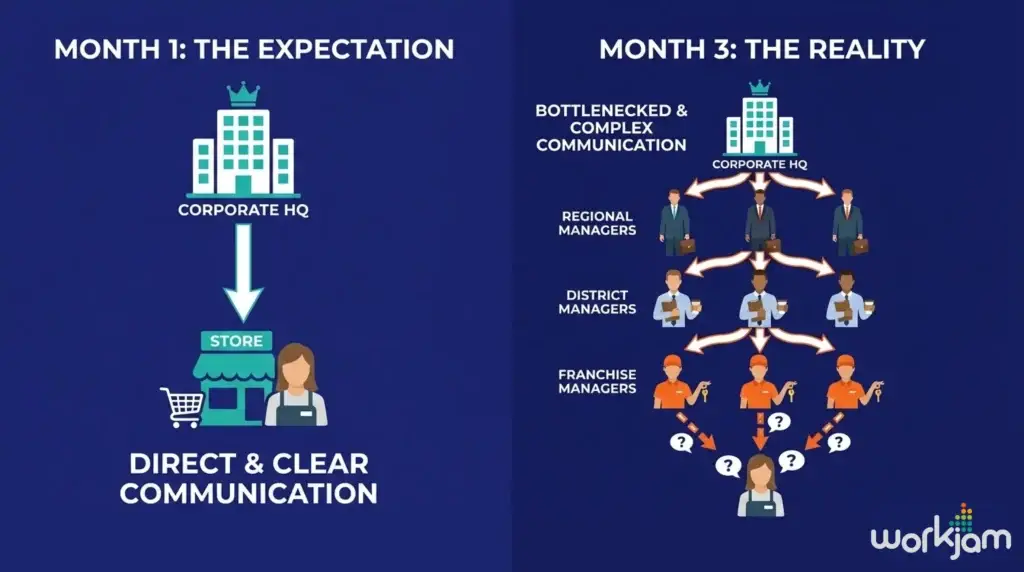
That is the trap: not a tool that fails at what it does, but a tool that cannot grow into the shape of your organization, discovered only after it is deployed. So it is worth asking early, of any platform, one plain question. Who is allowed to publish? Only HQ, or the parent company above you, the franchisees beside you, and the field leaders below you, each to their own people and under your standards? The answer is architectural. It costs nothing to ask before you sign, and a great deal to learn afterward.
Why Two Bad Options Result in Lost Control
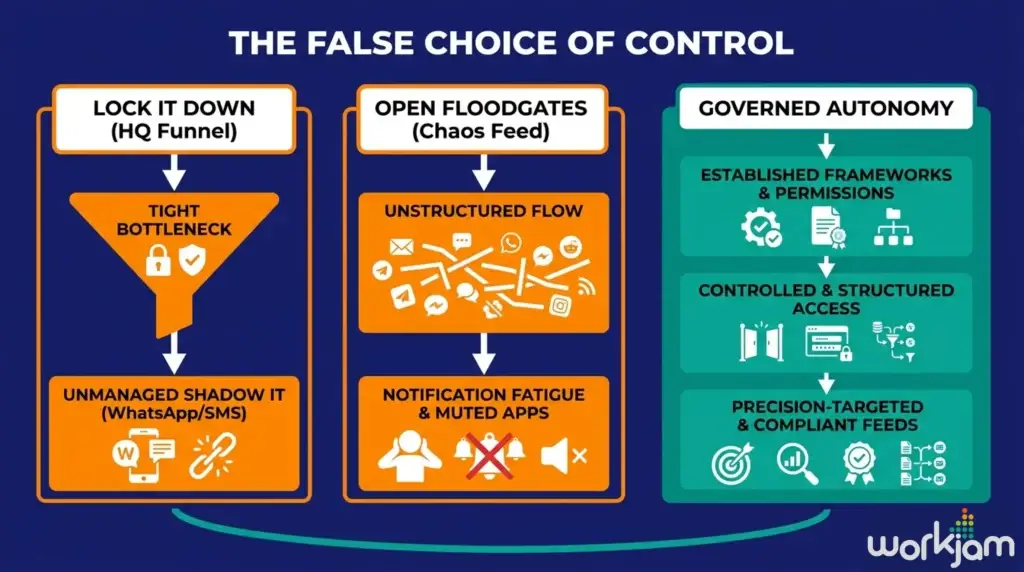
When you say no, the message does not disappear. It just goes out where you cannot see it. The store-specific update still reaches the staff, through a group text, a personal WhatsApp thread, a printout taped up in the break room. The control you were protecting was an illusion, because the communication simply routed around you.
That is what makes the usual choice a false one, and most frontline comms tools only offer that choice. Route everything through HQ, and you keep control of every word, but you become the funnel for communications you have no context to write, you slow the messages that are time-sensitive locally, and the message still leaks for the reason above. Open it up without structure, and you get the flood you feared: everyone posting to everyone, no standard, an app so noisy that employees stop reading what matters.
Both roads end in the same place. You lose control of the message and the experience. One of them just looks orderly while it happens.
Control Isn’t The Same as Being the Only Publisher
Control and sole authorship are not the same thing. Tools built to broadcast, to push one message from one place to everyone, made them feel identical, so the only way they know to protect a standard is to lock the door.
The real goal is a framework that decides who is authorized to publish what, at which level, and to which audience, with HQ holding the standards. Field leaders and franchise operators publish what they need to, to their own people, and no further. You are not giving up control. You are deciding where it lives.
Why WorkJam Built Delegated Publishing Rights
This is the part most tools skip, and it is why we built WorkJam the way we did.
WorkJam lets an organization authorize publishing at multiple levels inside one governed framework. HQ decides who can publish, at which level, and to whom. This is structural. The level a message comes from is not something you can configure in after the fact, it is how organizations are actually built, so the platform is built to match. Franchise operators and field leaders send their own operational communications to their own audiences, without routing through a central queue and without stepping outside the standards HQ set. And because every communication is targeted, employees see only what is relevant to them, so authorizing more publishers does not add noise. It removes the reason those local messages were leaking into channels you could never see in the first place.
That control is real and worth protecting, and it is worth being concrete about what protects it.
What Keeps You in Control: Target Audiences and Fencing
None of this asks you to trust that it will work out. The control is built into how publishing works, not promised around it.
You decide who can publish, at which level, and to which audiences. Authorization is granted, never assumed, so a franchise operator or a field leader reaches their own people and no one else, and only because you enabled it. Where you want a check before anything goes live, post approval workflows send a contributor’s post to you or a designated reviewer first, so publishing at a lower level never means publishing without review.
Precision targeting is what protects the employee experience. Because every post is delivered only to its intended audience, by role, location, and level, more publishers does not mean a fuller feed. Each employee still sees only what is theirs, so the app stays quiet even as the number of people posting grows.
Limiting noise is not only about what reaches someone. It is about what they see first. Much of protecting the message is deciding what leads: what matters most today, what gets featured, what sits at the top when an employee opens the app. Some tools organize that around an inbox; WorkJam organizes it around My Day, the view each person lands on, and you decide what rises to the top of it. Pinning and priority keep the message that matters above the ones that can wait, so adding publishers never costs you the ability to set what leads.
Underneath all of it are the guardrails you would expect: draft and scheduled states so nothing goes out before it is ready, post reporting, and shift, geo, and IP fencing that keeps communications on the clock and on site. None of it is exotic. Together it is the difference between decentralizing on purpose and hoping for the best.
The Quiet Reality of Losing Control
The fear is that decentralizing means losing control. Done without structure, it does. But refusing to decentralize loses control too. It just happens more quietly, in all the channels you cannot see.
Your organization was always going to communicate at every level it is built on. The only real question is whether that happens inside your standards, or around them.
About the author:

Josh Goldberg
Product Marketing Manager
Josh Goldberg is WorkJam’s Product Marketing Manager responsible for developing use cases, producing case studies, and researching frontline communication technology with analyst firms such as Gartner and Forrester. He also has two decades of experience writing content for B2C and B2B audiences in retail, technology, manufacturing, professional services, hospitality and events.